What is Selective Mutism (SM)?
Selective Mutism (SM) is a situational 'anxiety disorder' which affects both children and adults.
Children and adults with SM are physically capable of speaking. However they are persistently mute or struggle to speak in certain situations
(in the presence of certain people, for instance, or in certain environments) due to a complex, 'stable' system of anxieties which differs
from person to person.
The condition generally starts in early childhood but can (contrary to popular belief and even misinformation on other well-known
Selective Mutism websites) continue into adulthood.
The main, problematic stereotype these days (which is particularly problematic for those whose experiences of this condition were serious) is that SM is a school-only, childhood-only,
non-serious issue that has zero negative long-term ramefications.
*Our* simple statistic (used by some professionals without permission, by virtue of never crediting it to us) is that at least 1 in 2400 young adults have SM.
This is certainly an underestimate. In fact, while SM may seem innocuous in younger children (and is often downplayed as cute, easily solvable, behaviour by most professionals at the expense of those
for whom this is not the case), Selective Mutism may lead to additional mental health issues such as Depression, Generalized Anxiety Disorder (GAD),
self-harm, alcohol misuse, etc. Such outcomes are not always the case - of course. Some adults do get by as they are, supported by other people.
Others, however, encounter further - sometimes acute - mental health issues.
Want to know more?
Selective Mutism In Our Own Words
Our book features the life experiences of around 40 adults and children with personal experience of Selective Mutism.
Published by Jessica Kingsley Publishers, the book is available
in paperback (£14.99 / $21.47) and on Kindle (£12.75 / $19.31).
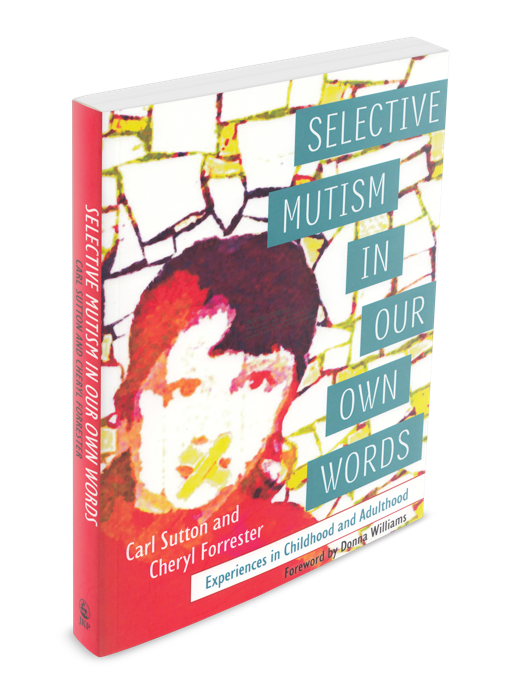
Read about Selective Mutism in the words of people who have experienced it
I often feel that I could no more use my vocal cords to break a silence, to get somebody’s attention or to initiate an interaction than I could run through fire or do something dangerous to my life.
- Wendy
Selective Mutism is like having your voice trapped inside your own mind. It’s feeling as if your throat is physically locked when you’re put in a position in which you are expected to speak and want to speak, but can’t. It’s feeling alone, because you’re ‘that kid who doesn’t talk’ and most people have never encountered anyone like you before, and they don’t understand why you can’t speak. It’s not being able to explain why you don’t talk, because even if you were able to speak to answer them, you don’t fully understand it yourself.
- Alison
Selective Mutism is commonly defined as the “failure to speak in certain social situations.” However, to me, it is so much more than that. On the surface, it appears as though the sufferer is choosing when and where to speak, however the truth is that rather than being deliberately silent in certain situations, it feels as though you physically can’t talk, like the words will not come out.
- Danielle